1972 Dodge Charger Se Baby Blue and White
| Contrivance Charger (1966) | |
|---|---|
 1971 Contrivance Charger | |
| Overview | |
| Manufacturer | Dodge (Chrysler) |
| Product | 1966–1978 |
| Body and chassis | |
| Class | Mid-size Muscle automobile |
| Layout | FR layout |
| Platform | B-body |
| Chronology | |
| Successor | Contrivance Magnum |
The Contrivance Charger (1966) also known as Dodge Charger (B-body) is a mid-size automobile that was produced past Dodge from 1966 to 1978, and was based on the Chrysler B platform.
Origin [edit]

1965 Dodge Charger II Show Auto
During the early 1950s, automakers were exploring new ideas in the personal luxury and specialty machine segments. Chrysler, slow to enter the specialty car market, selected their Dodge Division to enter the market with a mid-size B-bodied sporty motorcar to fit between the "pony auto" Ford Mustang and "personal luxury" Ford Thunderbird.[ane] The intention was to create a fastback look while sharing as much existing visitor hardware as possible.[1] utilizing lessons learned from the luxury coupe Chrysler 300.
The Coronet-based Charger that resulted[2] was introduced in mid-season of the 1966 model year in response to the Rambler Marlin, Ford Mustang, and Plymouth Barracuda. The styling was generally a deviation from the Dodge's mainstream cars.[3] The 1965 Marlin, along with the Charger that arrived during the 1966 model year, were two cars which set a new standard for radical fastback design in American mid-size automobiles.[iv] According to Richard M. Langworth, "because it was an intermediate like the Rambler Marlin, the Charger could take been an aesthetic disaster, simply long side windows prevented its sweeping roof from looking as well heavy."[5]
Burt Bouwkamp, Principal Engineer for Dodge during the 1960s and one of the men behind the Charger, related his experience during a speech communication in July 2004.
Lynn Townsend was at odds with the Dodge Dealers and wanted to practise something to please them. So in 1965 he asked me to come to his office - for the 2d time. He noted that one of the Contrivance Dealer Quango requests was for a Barracuda type vehicle. The overall dealer product recommendation theme was the aforementioned - nosotros want what Plymouth has. The specific request for a Mustang type vehicle was not as controversial to Lynn. His direction to me was to requite them a specialty auto but he said 'for God's sake don't make information technology a derivative of the Barracuda': i.e. don't go far a Barracuda competitor.
And then the 1966 Charger was born.
"Nosotros built a Charger 'idea' auto which nosotros displayed at auto shows in 1965 to stimulate market interest in the concept. It was the approved design but we told the press and motorcar prove attendees that information technology was just an "idea" and that we would build information technology if they liked it. Information technology was pre-ordained that they would like it." [6]
Start generation [edit]
| First generation | |
|---|---|
 1966 Dodge Charger | |
| Overview | |
| Model years | 1966–1967 |
| Body and chassis | |
| Body style | two-door fastback |
| Related | Contrivance Coronet Plymouth Belvedere Plymouth Satellite Plymouth GTX |
| Powertrain | |
| Engine | 318 cu in (5.ii L) 2bbl A V8 (1966) 318 cu in (five.2 Fifty) 2bbl LA V8 (1967) 361 cu in (5.ix L) 2bbl B V8 (1966) 383 cu in (half dozen.3 L) 2bbl B V8 (1967) 383 cu in (6.three 50) 4bbl B V8 426 cu in (seven.0 Fifty) two×4bbl Hemi RB V8 440 cu in (7.2 L) 4bbl RB V8 (1967) |
| Transmission | A230 3-speed manual A833 4-speed manual TorqueFlite 3-speed automatic |
| Dimensions | |
| Wheelbase | 117.0 in (2,970 mm) |
| Length | 203.6 in (5,170 mm) |
| Width | 75.8 in (1,930 mm) |
1966 [edit]
The Charger made its debut in mid-1966. Sharing its chassis and front-end sheet-metal with the mid-sized Coronet, the Charger was positioned to take on AMC's conceptually similar Rambler Marlin.[ane] It was meliorate looking, but somewhat more expensive, $2,850 to $3,100 ($22,733 in 2020 dollars [7]) to ($24,727 in 2020 dollars [7]).[8]
Significantly, the Charger's interior was different from all other cars, with a full-length middle console and "all bucket seating" front and rear, inspired by the 1960-1962 Chrysler 300. The rear'south pseudo-buckets could be folded down to create interior space attainable via the rear hatch.[9] The Charger was not intended to compete head-to-head in performancy with pony cars, only was available with Chrysler's famed 426 Hemi V8.[ix]
On January 1, 1966, viewers of the Rose Bowl were kickoff introduced to the new "Leader of the Dodge Rebellion", the 1966 Charger. The Charger's debut also followed by a half model twelvemonth the introduction of a new street version of the 426 cu in (vii.0 L) Chrysler Hemi engine. With the Charger, Dodge had a new model to build a performance paradigm to go on with this engine.
Designed past Carl "CAM" Cameron, the Charger introduced a fastback roofline and pot-metal "electrical shaver" grille, complete with fully rotating headlights, a characteristic not seen on a Chrysler product since the 1942 DeSoto. In the rear, the fastback design ended over a full-width half-dozen-lamp taillight with chromed "CHARGER" lettering.

1966 Charger musical instrument console
Inside, the standard Charger featured a simulated forest-grain steering wheel, four individual bucket seats with a full-length console from front to rear. The rear seats and rear middle armrest pad too folded forrard while the trunk divider dropped back, which allowed for cargo room.[10] Numerous interior features were exclusive to the Charger including door panels, courtesy lights, equally well every bit premium trim and vinyl upholstery. The instrument panel did not employ regular bulbs to lite the gauges, simply rather electroluminescence lit the four chrome-ringed circular dash pods, needles, radio, shifter-position indicator in the console, equally well equally clock and air conditioning controls if equipped. The nuance housed a 0 to 6000 rpm tachometer, a 0 to 150 mph (240 km/h) speedometer, as well as alternator, fuel, and temperature gauges as standard equipment.[10]
Engine selections consisted of simply V8s. 1966 transmissions included a three-speed steering-column mounted manual with the base engine, a console mounted four-speed transmission, or three-speed automatic. In 1966, four engines were offered: the base of operations-model 318 cu in (v.2 L) 2-barrel, the 361 cu in (v.9 50) 2-barrel, the 383 cu in (vi.3 Fifty) four-barrel, and the new 426 Street Hemi. Simply 468 Chargers were built with the 426.[xi]
Total production in 1966 came to 37,344 units for the mid-model year introduction.

1967 Charger NASCAR Spoiler
In 1966, Dodge took the Charger into NASCAR in hopes that the fastback would brand their car a winner on the high-banks. However, the car proved difficult to handle on the faster tracks because its body generated lift. Drivers would after claim that "it was like driving on ice." To solve this problem Dodge installed a pocket-sized lip spoiler on the trunk lid that improved traction at speeds to a higher place 150 mph (240 km/h). This was made a dealer-installed option in belatedly-1966 and in 1967, because of NASCAR rules, fabricated the 1966 Charger the first U.S. production vehicle to offer a spoiler. (Small quarter console extensions were added in 1967.) The addition of the spoiler helped David Pearson, driving the #6 Cotton Owens-prepared Dodge cars, to win the NASCAR Grand National title in 1966 with 15 first-place finishes, though simply one, the Capital Urban center 300 in Richmond, VA, was achieved using the Charger.[12]
1967 [edit]

The 1967 model year Charger received minor changes. Outside, new fender-mounted turn signals were introduced and this would serve every bit the master external identifier between a 1966 and 1967 Charger. A vinyl roof became bachelor. Inside, the full-length console was eliminated to satisfy customer complaints about the difficulty for entry and get out from the back seats. Information technology was replaced with a regular-sized panel. Bucket seats were standard, simply a folding armrest/seat and steering cavalcade transmission shifter was an option allowing three people to sit in the front.
The 440 "Magnum" was added and the 361 cu in (5.ix L) V8 was replaced past a 383 cu in (6.iii L) engine. The 440 was rated at 375 bhp (280 kW) with a single 4-barrel carburetor. The 318 two-barrel "LA" Chrysler LA engine was now the base engine with wedge-shaped combustion chambers, unlike the previous 1966 polyspherical (or "poly") design, information technology was rated at 230 bhp (170 kW). The 383 4-butt rated at 325 bhp (242 kW) and the 426 Street Hemi rated at 425 bhp (317 kW) remained every bit options. A full of 118 Chargers were built with the 426 engines in 1967, 58 cars were built with a four-speed transmission and 59 cars were built with the automatic transmission. The R/T parcel was also introduced in 1967.
Sales of the 1967 Chargers dropped to half of the previous introductory half-year with a total of 15,788 units.[13] According to automotive historian Patrick Foster, both the AMC Marlin and the very like looking first generation Contrivance Charger "flopped on the market equally sporty auto buyers were showing their preference for compact pony cars."[14]
Second generation [edit]
| Second generation | |
|---|---|
 1969 Dodge Charger R-T | |
| Overview | |
| Model years | 1968–1970 |
| Assembly | United states of america: Detroit, Michigan Hamtramck, Michigan Los Angeles, California St. Louis, Missouri |
| Trunk and chassis | |
| Body style | two-door hardtop |
| Related | Dodge Coronet Plymouth Belvedere Plymouth Satellite Plymouth GTX Plymouth Route Runner |
| Powertrain | |
| Engine | 225 cu in (three.7 Fifty) 1bbl I6 318 cu in (five.2 Fifty) 2bbl LA V8 383 cu in (half-dozen.3 L) 2bbl B V8 383 cu in (6.3 L) 4bbl B V8 426 cu in (7.0 Fifty) ii×4bbl Hemi V8 440 cu in (7.2 L) 4bbl RB V8 440 cu in (7.2 L) 2×3 RB (1970) |
| Manual | A904 3-speed automatic A727 three-speed automatic A230 three-speed manual A833 4-speed manual |
| Dimensions | |
| Wheelbase | 117 in (3,000 mm) |
| Length | 208 in (v,300 mm) (1968-69) 207.9 in (5,280 mm) (1970) |
| Width | 76.vii in (1,950 mm) (1968-69) 76.6 in (one,950 mm) (1970) |
| Height | 53.2 in (one,350 mm) (1968-69) 53.0 in (1,350 mm) (1970) |
1968 [edit]
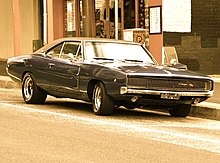
The entire B-body lineup for the 1968 model yr was redesigned and the Charger was further differentiated from the Dodge Coronet models. Less upscale than the first generation, the new model featured coke canteen styling by Richard Sias, with curves around the forepart fenders and rear quarter panels. Front end and rear end sail metal was designed by Harvey J. Winn. The rear finish featured a "boot up" spoiler appearance, inspired by Group seven racing vehicles. The fastback roof was gone, in favor of a "flying buttress" similar to that of the 1966-67 Pontiac GTO. The Charger retained its total-width hidden headlight grille, just a vacuum-operated cover replaced the electric motor powered rotating headlights. The previous total-width taillights were replaced with dual circular units at the direction of Styling Vice President, Elwood P. Engel. Dual scallops were added to the doors and hood.
Inside, numerous "downscalings" were axiomatic. A conventional stock-still rear demote seat replaced the folding bucket seat pattern. The conventional trunk surface area included a vinyl mat, rather than the previous model's carpeted cargo area. The center console in the front remained, but there was no center armrest. The tachometer was now optional and the electroluminescent gauges were replaced with a conventional design.
Even the model'southward engine options ended up reduced midyear, when the standard 318 cu in (five.2 Fifty) 2-bbl V8, was replaced with Chrysler'south basic 225 cu in (3.seven Fifty) slant-vi.[15] The 383-2 and 383-iv remained unchanged.
- R/T

A new high-performance packet was added, the R/T ("Route/Track", not to be confused with the Route & Track) magazine). The R/T came standard with the previous yr's 440 "Magnum", with the 426 Hemi optional. With either, the Charger had evolved into perchance the top Chrysler-made muscle car.[ix]
In 1968, Chrysler Corporation began a marketing campaign featuring a cartoon bee with an engine on its back promoting models called the "Scat Pack". The Coronet R/T, Super Bee, Sprint GTS, and Charger R/T received bumble-bee stripes (of two sparse stripes framing ii thick ones). The stripes were standard on the R/Ts and came in ruddy, white, or black, merely could exist deleted at no extra cost.
The 1968 moving picture Bullitt helped popularize the Charger R/T for its notable car chase sequence alongside the titular character's 1968 Ford Mustang GT through the streets of San Francisco, which has been regarded every bit one of the most influential car hunt scenes in film history. In the picture, a blackness Charger R/T 440 is chased by Steve McQueen'southward Ford Mustang GT, jumping on the San Francisco slopes.[sixteen] [17] The 1968 model year Charger sales increased to 96,100, including over 17,000 Charger R/Ts.
1969 [edit]

The 1969 model year brought few modifications. Exterior changes included a new grille with a center divider and new longitudinal taillights, both designed by Harvey J. Winn. A new trim line called the Special Edition (SE) was added. This could be available by itself or together with the R/T, thus making an R/T-SE. The SE added leather inserts to the front end seats but, chrome rocker moldings, a woods grain steering wheel, and wood grain inserts on the musical instrument panel. A sunroof was added to the options listing, but was ordered on just 260 Chargers. The bumblebee stripes returned, but were inverse slightly. Instead of 4 stripes, it now consisted of a wide stripe framed past two smaller stripes. In the middle of the stripe, an R/T cutout was placed. If the stripe was deleted, a metal R/T emblem was placed where the R/T cutout was. Total production was around 89,199 units.
At that place were two different 383 engines bachelor for the 1969 model year: two-barrel and 4-barrel. The 2-barrel was rated at 290 hp. The four-barrel engine was rated at 330 hp and was identified on the air cleaner every bit "383 / FOUR BARREL". The 330-hp engine was unique to the Charger model in 1969. While this engine was available with an un-silenced air cleaner option, information technology differed internally from the 335-hp 383 "Magnum". Differences between the 330-hp 383 4-butt and 335-hp 383 magnum were generally internal. Both versions used the Carter AVS carb and the larger frazzle manifolds from the 440 Magnum engines, merely the Magnum had a windage tray in the oil pan, a different camshaft profile, and different valve springs. In 1969 the B-series engines were all painted Chrysler Engine Turquoise with the exception of the iv-barrel 383 four-speed and 440 Magnum engines which were painted Chrysler "Loftier-Performance Orange". As usual, the 426 Hemi was painted "Street Hemi Orange". The 383 Magnum motor was used in Route Runners and Super Bees, but did not appear in a Charger body until 1971.
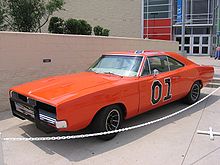
The television series The Dukes of Hazzard (1979–1985) featured an orange-painted 1969 Charger named The General Lee. "The General" sported the Confederate battle flag painted on the roof and the words "GENERAL LEE" over each door. The windows were always open, as the doors were supposedly welded shut for racing, and the actors would practise a window slide to go far and out. The number "01" is painted on both doors. Likewise, when the horn push was pressed, it played the first 12 notes from the de facto Amalgamated States anthem "Dixie". The car performed spectacular jumps in almost every episode, and the show's popularity produced consumer interest in the car.
Charger 500 [edit]

In 1968, the NASCAR inspired Charger R/T failed to beat the Ford cars (the Ford Torino Talladega and the Mercury Whirlwind Spoiler II) on the high-banks oval-tracks. Wind tunnel tests showed the tunneled rear window caused lift and the gaping oral fissure induced drag. Every bit a result, Dodge made the rear window flush with the rest of the roof and put a 1968 Coronet grille in the front.
The original Charger 500 image was a 1968 Charger R/T with a 426 Hemi and automated transmission. The prototype was painted in B5 Blue with a white stripe, too every bit a white interior. The Charger 500 was one of three models introduced in September 1968. The standard engine was the 440 Magnum, only mill literature described the 426 Hemi was standard. The Charger 500 had the Torqueflite standard and the same equipment standard as the R/T.
A total of 392 Charger 500s were made, of which only 67 had the 426 Hemi engine; 27 with a 4-speed and 40 with an automatic transmission.
Charger Daytona [edit]

Contrivance was not satisfied with the results of the Charger 500. The motorcar was non enough to beat the other aerocars on the NASCAR circuit. After months of inquiry and development, including at the aftermarket shop, Artistic Industries, the Charger Daytona was introduced on April 13, 1969. Information technology quickly received over 1,000 orders.
Chrysler fabricated many attempts at improving the aerodynamics of the 500 past adding noses rumored to exist up to 23 in (580 mm) long. The Charger Daytona finally received an 18 in (460 mm) nose. The full-size Charger Daytona was tested with an 18 in (460 mm) olfactory organ at the Lockheed-Martin Georgia facility. The exam was a success and the projection was greenlighted. The nose piece was only part of the innovation. The Charger Daytona as well received a 23 in (580 mm) tall wing in rear. This wing was bolted through the rear quarter panels and into the rear subframe. Although proven to be less effective than shorter wing designs, the engineer responsible for the development of the wing, John Pointer, chose the tall blueprint and then the wing would be in "make clean air" to help increment the car'southward overall speed. That the tall wing prevents interference with the operation of the trunk lid tin can exist considered a fortunate coincidence.[xviii] The alpine wing also helped in an unintended fashion, by giving the car directional stability due to its securely splinted sides.
The Charger Daytona engineering model was tested on the Chelsea, Michigan Chrysler Proving Grounds on July twenty, 1969. Driven past Charlie Glotzbach and Buddy Bakery, information technology was clocked at 205 mph (330 km/h) with a small four-bbl. carb. The Charger Daytona'southward olfactory organ made i,200 pounds of downforce and the wing made 600 pounds of downforce. The Dodge styling department wanted to make changes to the Charger Daytona every bit soon as they saw information technology, simply was told by Bob McCurry to back off; he wanted function over finesse.
The Charger Daytona introduced to the public had a fiberglass nose without real headlamps and a wing without streamlined fairings. The media and public loved the car, merely were mystified by the reverse scoops on the front end fenders. The PR representatives claimed it was for tire clearance. Really, they reduced drag by three% by ventilating trapped air out of the wheel wells.
The Charger Daytona came standard with the 440 Magnum Engine with 375 hp (280 kW) and 480 lb⋅ft (650 N⋅thousand) of torque, A727 Torqueflite Automatic Manual, and a 3.23 489 Example eight 3/4 Chrysler Differential. Optional was the 426 Hemi with 425 hp (317 kW) and 490 lb⋅ft (660 N⋅k). The 426 Hemi was also available with the no price option of the A833 4-Speed Transmission. Only 503 Charger Daytona's were produced as U.S. cars. (An additional 40 were for Canada), Of the 503 U.Due south. cars produced, 433 were 440 Magnum, 139 4-Speed and 294 Torqueflite; 70 were 426 Hemi power, 22 4-Speed and 48 Torqueflite.
In the end, the Daytona was brought down by the determination to make the 1970 Plymouth Superbird the merely Chrysler winged car for the model yr. While Daytonas were raced through the 1970 flavor, only one Daytona was raced until 1971 (in the 1971 Daytona 500) when NASCAR decreed that engine displacement of wing cars would exist limited to 305 cu in (5.0 L). That detail machine, driven past Dick Brooks, finished in 7th place. The very beginning 1969 Charger Daytona was hand-built past Chrysler engineers and was on display at the 1969 Earth fair in New York.
1970 [edit]
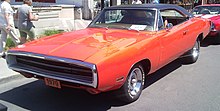
The Charger was changed slightly for the 1970 model year. This was the last twelvemonth of the 2nd generation Charger and featured a large wraparound chrome bumper and the grille was no longer divided in the middle. New electric headlight doors replaced the old vacuum style. The taillights were similar to those used in 69, but 500 and R/T models came with a new more attractive taillight panel. On the R/T, new rear-facing scoops with the R/T logo were mounted on the front doors, over the door scallops. A new 440 or HEMI hood cutout made the choice list for this twelvemonth simply.
Dodge painted the hood scallop inserts black and put the silver engine callouts on top. New "High Impact" colors were given names, such every bit "Top Banana", and "Panther Pink".[nineteen]
Interior changes included new high-dorsum bucket seats, the door panels were also revised and the map pockets were now optional instead of standard. The ignition was moved from the dash to the steering column (as with all Chrysler products this year), and the glove box was now hinged at the bottom instead of the top as in 1968–69. The SE "Special Edition" trim choice added luxury features and was bachelor in the 500 SE and R/T SE versions. A new pistol grip shifter was introduced, along with a demote front seat, a first for the Charger since its debut.
A new engine selection made the Charger's list for the first fourth dimension, the 440 Six Pack. With three two-barrel carburetors and a rating of 390 hp (290 kW), it was ane of the near exotic setups since the cross-ram Max Wedge engines of the early 1960s. The Six Pack was previously used on the mid-year 1969 Dodge Super Bee and Plymouth Route Runner. Despite this new engine, production slipped again to 46,576 mainly due to the new E-trunk Contrivance Challenger pony car, equally well as rapidly increasing auto insurance rates. In the 1970 NASCAR season, the 1970 Charger had ten wins, more than than whatever other machine, including the 1969 Charger Daytonas and Plymouth Superbirds, thus giving Bobby Isaac the Grand National Championship. Buddy Baker, driving the blue #88 Engineering Daytona, was the first and only legal auto to run over 200 mph in 1970. That record lasted for over thirteen years.
Third generation [edit]
| Third generation | |
|---|---|
 1971 Contrivance Charger | |
| Overview | |
| Model years | 1971–1974 |
| Assembly |
|
| Body and chassis | |
| Body style | 2-door hardtop/coupe |
| Related |
|
| Powertrain | |
| Engine |
|
| Manual |
|
| Dimensions | |
| Wheelbase | 115.0 in (ii,921 mm) |
| Length | 205.0 in (v,207 mm) |
| Height | 53.0 in (one,346 mm) |
1971 [edit]
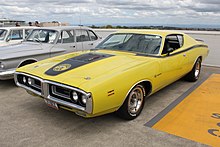
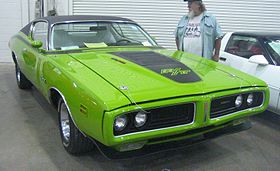
The third generation Charger made its debut for the 1971 model year, with all new "fuselage" sheetmetal and a new split grille. The interiors were like those of the E-body and were now shared past the Plymouth B-body, the Plymouth Satellite Sebring, and Route Runner. The hidden headlights were now optional. A rear spoiler and a "Ramcharger" hood were new options. This hood featured a pop-up scoop mounted in a higher place the air cleaner controlled past a vacuum switch under the nuance. On Plymouth Road Runners information technology was called the "Air Grabber" hood, and it was previously used on the Coronet R/T and Super Bee.
Dodge also merged its Coronet and Charger lines. From 1971, all four-door B-bodies were badged as Coronets and all two-door B-bodies equally Chargers. Thus for one year only, the Super Bee became office of the Charger lineup, later which it was discontinued. From 1971 to 1974, Charger models used the Coronet's VIN prefix of "Westward".
Several other models were carried over from 1970, including the 500, R/T, and SE. Sales of the R/T declined due in part to college insurance costs and gasoline prices. A total of 63 Hemi RTs were built that year, marking its last appearance in whatever product auto, and two,659 with other engines. The 1971 model year was also the last for the 440 Six-Pack engine, which could still be mated to a 4-speed manual transmission with an optional Hurst shifter, equally well as the automatic. In the Super Bee'southward final year, the 340 became a $44 option over the standard, low-pinch 383 V8.
The "Hi-Bear upon" colors were discontinued after the 1971 model twelvemonth; with a 1971-only "Citron Yella".
1972 [edit]

The 1972 Charger introduced a new "Rallye" pick to supersede the R/T version. The SE was differentiated from other 1972 Chargers by a unique formal roof handling and hidden headlights. The 383 engine was replaced with a lower compression 4-barrel 400, while the 440 engine was rated at a more than realistic 280 hp (209 kW; 284 PS) net instead of the previous 350 hp (261 kW; 355 PS) gross. Outset in 1972, all engines featured hardened valve seats to permit the employ of regular leaded or unleaded gasoline rather than leaded premium fuel as in past years due to tighter emissions regulations. Though the 440+6 (designating a triple 2-barrel carb setup and 310 bhp (231 kW; 314 PS) was listed in the early 1972 sales literature, it was establish in the August 1971 testing that this engine would non meet the new and more stringent 1972 emissions laws, although some early Dodge literature (August 1971 press) stated that this engine was available for 1972, and a few (six is the accustomed number) factory installed half dozen-pack Chargers were built, the engine was dropped out of production by September 1971. The optional Pistol-Grip 4-speed Hurst manual shifter could exist coupled to the 340, 400, and 440 Magnum engines. The Ramcharger hood scoop was discontinued, too every bit optional lower geared performance rear axle ratios and extra heavy-duty suspensions. It was also the final year for the Dana sixty differential and was available only in combination with the 440/4 speed, heavy-duty suspension, and the three.54:one rear beam ratio.
The only remaining "Hi-Impact" color choices were "Hemi Orange" (EV2) and "Elevation Banana" (FY1), the latter was available under different names through 1974.
1973 [edit]


For the 1973 model year, Chargers received new sail metal and were longer, wider, and slightly taller than the 1971-72 cars. As well new were vertically slatted taillights and new grilles. Hidden headlights were dropped, fifty-fifty as an selection.
The 318 was still standard, with the 340 (bachelor simply on the Rallye), 360 (2-barrel only), 400 (depression power 2-barrel/single frazzle and high-operation 4-barrel/dual exhaust), and 440 remaining as options.
The SE models had a new roof treatment that had a "triple opera window" surrounded past a canopy-way vinyl roof. All other models had a new quarter window treatment, discontinuing its AMC Gremlin-fashion window in favor of a more conventional design.
Full sales this yr were around 108,000 units, the highest always for the 1971-74 Charger generation, though more than 60 percent of the cars had not-high performance engines. The 1973 Chargers, and all Chrysler products, were equipped with five mph bumpers, front and rear.
1974 [edit]
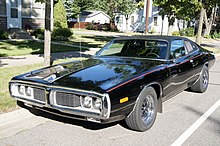
The 1974 model year saw minor changes that included new colour choices, a softer grain design on interior surfaces, and a slight increase in the size of the rubber bumper tips. The 340 pick was replaced with a 360 iv-bbl equally the pocket-size-block performance engine. All other engine options remained the same, including the 360 2-bbl designated by a Chiliad in the fifth symbol in the vehicle identification number. Several performance rear-end ratios, including a iii.23 "Sure Grip" rear terminate were available. A four-speed transmission was an option except with the 440 engine.
In spite of the Charger no longer being perceived as a operation model, sales rose as it veered towards being a personal luxury automobile. The musculus-car era came to a close, with 1974 as the final year for performance options.
NASCAR [edit]
The 1971-74 Charger based cars were campaigned in NASCAR, with Buddy Baker, Bobby Isaac, Dave Marcis, and Richard Little scoring several wins. Richard Piffling won 35 races with this body mode between 1972 and 1977 as NASCAR allowed the Chargers to run a few years longer than normal considering Chrysler did not have a replacement auto. A 1974 bodied Charger driven by Neil Bonnett scored Dodge's last NASCAR victory (until 2001) at the December 1977 Los Angeles Times 500. Richard Piffling has proclaimed this body style equally his favorite motorcar that he ran during his career because it was counterbalanced.
Fourth generation [edit]
| 4th generation | |
|---|---|
 1975 Dodge Charger | |
| Overview | |
| Model years | 1975–1978 |
| Assembly | United States: Detroit, Michigan Hamtramck, Michigan St. Louis, Missouri Canada: Windsor, Ontario |
| Torso and chassis | |
| Body mode | two-door coupe two-door hardtop/coupe (1976 Sport two-door model but, also refer to the 1975 Dodge Coronet 2-door model) |
| Related | Dodge Coronet Chrysler Cordoba Plymouth GTX Plymouth Fury |
| Powertrain | |
| Engine | 318 cu in (five.2 L) V8 360 cu in (five.9 L) V8 400 cu in (six.six 50) V8 |
| Transmission | 3-speed automatic 3-speed manual iv-speed manual |
| Dimensions | |
| Wheelbase | 115.0 in (2,921 mm) |
| Length | 216.0 in (5,486 mm) |
| Pinnacle | 52.0 in (ane,321 mm) |
1975 [edit]

The 1975 model year Charger picked up on the sales increase seen in 1974's move towards positioning it equally a personal luxury car.[20] Both the Charger and the new Chrysler Cordoba sibling shared the same torso based on the B platform.
The Charger SE (Special Edition) was the only model offered. It was bachelor with the 318 cu in (5.2 L) "LA" series modest block V8 and three versions of 400 cu in (half dozen.6 L) large-block V8. The standard engine was the 360 cu in (5.9 L) ii-bbl small block. The code E58 4-bbl and dual exhaust high performance version (225 hp) were optional.[21] Sales in 1975 totaled 30,812.
Because of the farthermost squareness of the body design, NASCAR teams were forced to rely on the previous years (1974) canvas metal for race-spec cars. In order for Dodge to be represented, NASCAR allowed the 1974 sheet metal to be used until January 1978, when the new Dodge Magnum was ready for race use. In 1976 a Charger was i of two NASCAR stock cars to compete in the 24hrs at LeMans, having been modified with head-lamps, tail-lamps, and windshield wipers. Information technology was driven by Herschel and Doug McGriff and sponsored by Olympia Beer, earning the nickname "Oly Express"[22]
1976 [edit]
The 1976 model twelvemonth Charger range was expanded to four models; base, Charger Sport (formerly the Dodge Coronet 2-door model, which appeared for just the previous model year but), Charger SE, and the Charger Daytona. The base and Sport models used a different trunk than the SE and Daytona, and were essentially a re-badging of what had been the 1975 Dodge Coronet 2-door models — and available with a 225 cu in (3.7 L) Slant Six, which was not offered on the SE and Daytona. The Charger Daytona was introduced as an appearance package and was offered with either the 360 or 400 engine. Sales for 1976 increased slightly to 65,900 units.
1977 [edit]
In 1977, the Charger Sport (which dated back to the one-time Coronet two-door, which had appeared for only the 1975 model year only) and the base of operations Charger were dropped as this body style became part of the newly named B-body Monaco line, and merely the Charger SE and Charger Daytona were offered. Estimated production was 30,367 units.[23]
1978 [edit]
The 1978 model twelvemonth was a carry-over and the terminal use of the B-Body. A full of 2,735 Chargers were produced.
The Magnum replaced the Charger as Dodge'southward B-body personal luxury motorcar and its sales increased.[24]
References [edit]
- ^ a b c Severson, Aaron (27 November 2007). "Dodging the Issue: The Original Contrivance Charger". Ate Up With Motor . Retrieved 3 Dec 2015.
- ^ History of the American Auto. Publications International. 2004. p. 415. ISBN9780785398745 . Retrieved 3 Dec 2015.
- ^ Grist, Peter (2007). Contrivance dynamite! sixty years of Dodge musculus cars. Veloce. p. 64. ISBN9781845841126 . Retrieved three Dec 2015.
- ^ "Fish story: AMC's Marlin". Cars and Parts. 36: 20. June 1993. Retrieved three December 2015.
- ^ Langworth, Richard M. (2000). Complete Volume of Collectible Cars: seventy Years of Blue Chip Auto Investments 1930-2000. Publications International. p. 154. ISBN9780785343134 . Retrieved iii December 2015.
- ^ Bouwkamp, Burton (July 2004). "Birth and decease of the original Dodge Charger: Dodge'south Burt Bouwkamp speaks". Allpar.com . Retrieved 3 December 2015.
- ^ a b 1634–1699: McCusker, J. J. (1997). How Much Is That in Real Coin? A Historical Price Index for Use as a Deflator of Coin Values in the Economy of the U.s.: Addenda et Corrigenda (PDF). American Antiquarian Guild. 1700–1799: McCusker, J. J. (1992). How Much Is That in Existent Money? A Historical Price Index for Use equally a Deflator of Money Values in the Economy of the United States (PDF). American Antiquarian Order. 1800–present: Federal Reserve Bank of Minneapolis. "Consumer Cost Index (estimate) 1800–". Retrieved one January 2020.
- ^ Mueller, Mike (2009). The consummate book of Contrivance and Plymouth muscle. Motorbooks. pp. 91–92. ISBN9780760330791 . Retrieved 3 Dec 2015.
- ^ a b c Holder, William G.; Kunz, Phillip (2003). Chrysler muscle: Detroit'south mightiest machines. Krause Publications. p. 42. ISBN9780873496339 . Retrieved 3 Dec 2015.
- ^ a b Genat, Robert; Newhardt, David (2004). Mopar Muscle: 50 Years. MBI Publishing. pp. 115–117. ISBN978-0-7603-2016-vii.
- ^ Mueller, Mike (2003). Musclecar Icons. MBI Publishing. p. 262. ISBN978-0-7603-1773-0 . Retrieved 3 December 2015.
- ^ "1966 Nascar Grand National Results". racing-reference.info . Retrieved 21 February 2022.
- ^ Auto Editors of Consumer Guide (xvi October 2007). "1967 Dodge Charger Sales". car.howstuffworks.com. Archived from the original on 2 August 2020. Retrieved 21 February 2022.
{{cite web}}: CS1 maint: uses authors parameter (link) - ^ Foster, Patrick R. (1993). American Motors, the last independent. Krause Publications. p. 111. ISBN9780873412407 . Retrieved three Dec 2015.
- ^ Palmer, Jamie (two May 2019). "One Of 906! 1968 Slant-6 Contrivance Charger". Barn Finds . Retrieved 7 July 2020.
- ^ Kunz, David; Bologna, Anthony; Ullrich, Scott; Kohrn, Wolfgang (21 Baronial 2011). "1968 Bullitt Charger R/T". Ponysite.de . Retrieved 21 February 2022.
- ^ Movieclips (ane Feb 2017). "Bullitt (1968) - San Francisco Machine Hunt Scene (4/10)". YouTube. Archived from the original on 19 December 2021. Retrieved 3 April 2018.
- ^ "The Real Reason the Dodge Charger Daytona'southward Wing Was So Huge". Roadandtrack.com. 27 June 2016. Retrieved 28 June 2016.
- ^ "Panther Pinkish, one of the wildest colors to e'er come out of an American car company". Pantherpink.com . Retrieved 3 December 2015.
- ^ "Identity Crisis: Dodge Charger". fornoob.com. 2021. Retrieved 22 Feb 2022.
Dodge attempted to sell the quaternary generation Charger equally a luxurious family coupé, unlike the Charger'due south predecessors.
- ^ "Dodge Charger SE 1975 fourth Generation (1975-1978)". motorcar.info.
- ^ Smit, Dylan (2016). "Helpless Hulk - 1972 Dodge "Olympia" Charger NASCAR". carmrades-blog.com.
- ^ Wilson, Gerard (16 Nov 2020). "Dodge Cars and Production Numbers, US". Allpar . Retrieved 21 Feb 2022.
- ^ Damian, Alex (6 April 2006). "1968 - 1978 Dodge Charger RT History". Summit Speed. Retrieved 22 February 2022.
External links [edit]
- "All-time and Worst Paint Colors". Four Wheel Migrate.
Source: https://en.wikipedia.org/wiki/Dodge_Charger_(1966)
0 Response to "1972 Dodge Charger Se Baby Blue and White"
Post a Comment