Reading Passage on George Washington for Children
Americans call George Washington "the male parent of our country."
About people know him best as the showtime president of the U.s., from 1789 to 1797. But the list of his accomplishments is long. Washington commanded the Continental Army in the Revolutionary State of war. He led the American colonists to liberty from British rule. He was also president of the convention that created the U.Due south. Constitution.
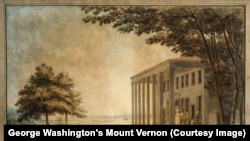
In his private life, Washington owned a big whiskey distillery and thousands of acres of land. He operated a big and successful farm. When the Revolutionary War was over, Full general Washington wanted to go home to his Virginia estate, called Mount Vernon.
Joseph Ellis is a historian and prize-winning author who wrote a book called "His Excellency: George Washington."
"He didn't want to be president. No president in American history did non want to be president more than George Washington."
But other leaders asked him to go the first president under the Constitution. Every elector voted for him. Washington accepted the job as his duty.
Washington as president
When George Washington was sworn in as president in 1789, the idea of a truly u.s.a. was yet simply an idea. Americans were unconnected social, economic and ethnic groups. For example, a quarter of the people in the state of Pennsylvania spoke just German. The new president would have to establish a social and political spousal relationship nether the Constitution.
But the Constitution did non say in detail how the president could practice that. Doug Bradburn, founding managing director of the Washington Library at Mount Vernon, says George Washington invented the job of president.
"I retrieve that what people don't approximate in their scale of judging his skill as a political figure is just how frail the land was, that the chances it would even survive were probably very, very slim."
Mr. Bradburn says President Washington set many important precedents for all the presidents who followed him. First, he was not merely a figurehead only a decision maker.
He established a grouping of advisors, the cabinet. They became a very important part of the presidency, or executive branch. Washington chose strong people to lead the departments. Sometimes those cabinet members disagreed strongly, but Washington managed them well.
President Washington also established the nation's official currency and the Section of Strange Affairs, now called the Country Department. He created a half-dozen-fellow member Supreme Court.
And, Washington said the president should set strange policy. That responsibleness was not clear in the Constitution.
Mr. Bradburn says Washington took his job very seriously and e'er used the Constitution as his guide.
"He wasn't but trying to establish an office and then figure out a way to justify it, he was trying to work with his Constitution."
As president, George Washington travelled around the country. In Rhode Island, he wrote to the Hebrew Congregation at Truro. The letter spoke eloquently about the rights of Jews. Mr. Bradburn says this letter is "tremendously pregnant." Supporting the Jews and their religion was a revolutionary act of acceptance for its fourth dimension.
Washington as a fellow

George Washington was built-in in 1732 in Virginia. His father died when George was eleven years old. As a boy, he learned reading, writing and math. Then he worked as a land surveyor in western Virginia.
In his twenties, he became a British Ground forces officer. George Washington fought in the French and Indian War.
Mr. Ellis points out that Washington did not accept a formal or college education similar many other early U.Southward. leaders, including John Adams and Thomas Jefferson.
"But in some sense, Adams goes to Harvard, and Jefferson goes to William and Mary and Washington goes to war."
Mr. Ellis says the first president was "a realist." At the aforementioned fourth dimension, he was a "very passionate man" with "extremely stiff emotions." He was known to get angry, but he only showed his atmosphere to a few people.
Washington non merely acted like a bully leader – he looked similar i. George Washington stood about 1.9 meters tall. He was a head taller than the average man of his time.
He was very strong, and very svelte. He was known as i of the all-time horseback riders and best dancers in Virginia.
But he had a problem: bad teeth.
Different his wife, Martha, who was known for her lovely smile, George Washington began losing his teeth in his twenties. When he was sworn in as president, he had only i molar left.
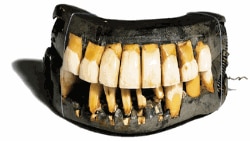
Dentists fabricated him sets of dentures from uncomfortable metal and springs. Some of the teeth were from hippopotamus ivory. Mr. Ellis says Washington even paid some of his slaves for their teeth.
"Near six of the teeth in his mouth in his latter years, when he is president, are actually from slaves at Mount Vernon."
Washington as a myth
Even today people tell stories near George Washington. One popular story, that he had wooden teeth, is not true.
And he did non chop down a ruby tree as a kid and and so acknowledge it by proverb, "I cannot tell a lie." In fact, historian Joseph Ellis says George Washington "lied many times."
But as Washington became more famous, his reputation equally a man who e'er did the right thing grew. Mr. Ellis tells well-nigh one artist who painted Washington'south portrait. The creative person painted what he thought people wanted to see, instead of what he really saw.
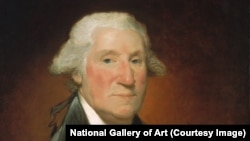
"When the creative person was painting one of his famous presidential portraits in 1795, and it'due south the famous Vaughan portrait, it's of the icon. But he said, 'equally I looked at him he looked to me similar the wildest creature in the forest,' but that's not what he painted."
Mr. Ellis says even George Washington understood people would look at his writings and estimate him in history.
"At some bespeak in his life, probably during the war, Washington went from being a man to a monument. He was aware of the fact that he had a office to play and that all emerging nations need mythical heroes."
Washington became very protective of his personal thoughts. His married woman, Martha, whom he married in 1759, burned most of their letters when her hubby died.
Doug Bradburn of the Washington Library at Mount Vernon says people can know the first president past his actions. He says George Washington had an unusual range of abilities.
"As a pol, you know, as a statesman, as a military machine figure. These are all things that he develops through practice and through reading."
George Washington had i chief regret. He told a close aide that he wished he had been able to exercise something about slavery. When he died, on December 14, 1799, George Washington freed his slaves in his volition. He also gave money to the slaves and their children to receive an instruction.
Historian Joseph Ellis says one of the best things almost George Washington was his ability to surrender power.
"One of his greatest assets was he was a great aficionado of exits, of giving up ability. You could trust Washington with power because he was then conspicuously willing to requite information technology upwards."
At the cease of the Revolutionary War, Washington gave upwards his sword. And at the terminate of his presidency, Washington merely went dorsum to Mountain Vernon.
Doug Bradburn says Washington was the right man to be the father of the land and first president. Mr. Bradburn, like many historians, calls George Washington the "indispensable homo." He made ideas well-nigh American freedom and government existent, and he showed that even the president would operate under the rule of law.
I'one thousand Anne Ball.
Anne Brawl reported and wrote this story. Kelly J. Kelly was the editor.

______________________________________________________________
Words in This Story
achievement – north. something washed or achieved successfully
distillery – n. place where alcoholic drinks are produced
precedent – northward. a similar action or event that happened before
figurehead – n. a person who is called the caput of something but who has no real power
eloquently – adv. having or showing the ability to use linguistic communication clearly and finer
surveyor – n. a person whose job is to measure and examine an area of land
atmosphere – due north. the tendency of someone to become angry
graceful – adj. moving in a smooth and bonny way
denture(due south) – n. a set of bogus teeth
icon – n. a person who is very successful and admired
will – n. a legal certificate in which a person states who should receive his or her possessions afterward he or she dies
addict –due north. a person who likes and knows a lot about something
conspicuously – adv. very like shooting fish in a barrel to see or observe
indispensable – adj. extremely important and necessary
Source: https://learningenglish.voanews.com/a/george-washington-profile/2926816.html
0 Response to "Reading Passage on George Washington for Children"
Post a Comment