How to Upload Official Audio Art to Youtube
What is an Fine art Track?
The features described in this article are available only to partners who use YouTube's Content Manager to manage their copyrighted content.
An Art Rails is an automatically generated YouTube version of a sound recording. An Art Track consists of the sound recording, the album art, and metadata about the recording, such as its championship and artist name.
The purpose of Art Tracks is to provide a unmarried official, label-sanctioned YouTube version of every audio recording. Currently, official music videos are available for recordings but when a label or artist invests (non-lilliputian) time and resources into producing one. Art Tracks automate the creation of versions for recordings that don't have a produced music video.
YouTube creates one Art Track for each audio recording that you upload using the YouTube Music DDEX feed or the"Audio – Art Tracks" majority upload spreadsheet. It identifies recordings based on their ISRC. If you upload multiple instances of the same ISRC (for case, if the recording appears on multiple albums or as function of a compilation), YouTube creates the Art Track using the version with the primeval release date in each territory.
Fine art Tracks fill up in the gaps to ensure that YouTube has a complete music itemize. They announced in the same places as produced music videos, such as on the YouTube topic aqueduct for the main artist, in album playlists, and in search results, including watch cards for the artist. YouTube uses the produced music video for recordings that have ane; when yous upload a music video for a sound recording, the Art Rails for that recording becomes unlisted and undiscoverable.
Creating Art Tracks
To create Art Tracks for your sound recordings, you upload the recording and artwork media files along with a metadata file that describes the recording. You lot tin provide the metadata in i of two formats:
- An manufacture-standard DDEX Electronic Release Notification (ERN) feed
- An "Sound – Art Tracks" bulk upload spreadsheet.
YouTube creates the Art Track based on the values you provide in the file; see below for details near how the metadata values impact the resulting Art Rails.
Sound recordings that y'all upload for Art Tracks are not used for the YouTube rights direction system or Content ID. To create audio recording assets for rights management or Content ID, use the YouTube Rights Administration Feed XML format or the "Sound – Sound Recording" bulk upload spreadsheet.
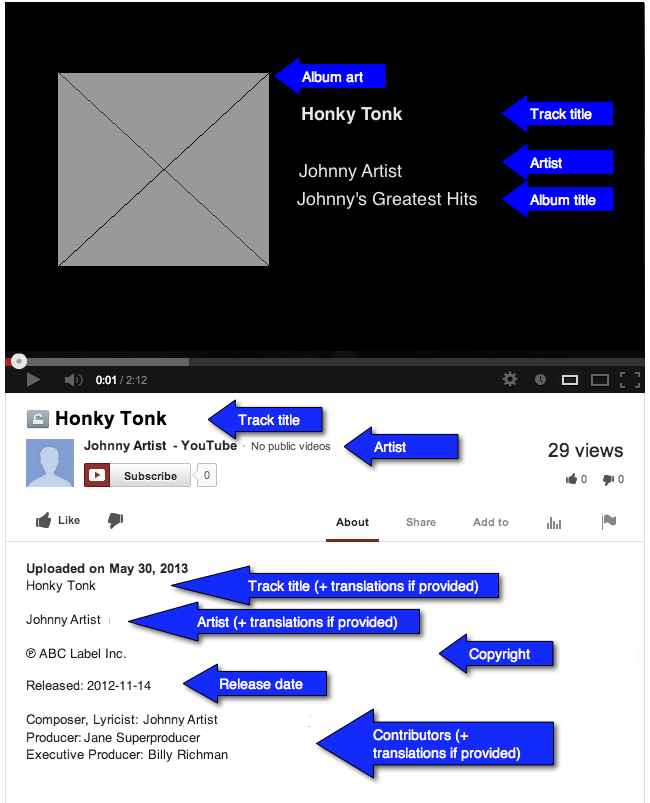
The Art Runway consists of the artwork provided for the album and data near the track. If a track appears on multiple albums, the Art Rail shows the artwork and title for the anthology with the earliest release date.
The table below identifies the element in the DDEX file that YouTube uses for the track information. If the element in the Primary DDEX source cavalcade does not exist in the message, YouTube uses the value from the chemical element in the Secondary DDEX source column. The items with an asterisk evidence in the Description associated with the Fine art Track, non in the Art Rails itself.
YouTube does not support per-territory metadata. If the message includes multiple versions of the metadata for a track, YouTube uses merely the version that appears outset in the message.If you lot include translated titles or artist names, the translations appear alongside the original linguistic communication text in the Clarification; the Art Rails uses simply the original linguistic communication. More about providing translated titles and names.
| Information | Principal DDEX source | Secondary DDEX source |
|---|---|---|
| Album art | If a release has more than one | None |
| Track championship | |
|
| Artist | If a track has more than i | |
| Anthology title | plus optional | plus optional |
| Copyright* | <PLine> If the rails doesn't have a <PLine> element, the Art Track description uses the <PLine> element for the anthology | <CLine> If the track doesn't take a <CLine>element, the Art Runway description uses the <CLine> chemical element for the album |
| Release appointment* | <ReleaseDetailsByTerritory> <OriginalReleaseDate> | None |
| Contributors* | The Fine art Rails clarification lists each contributor on a separate line, with a comma-separated list of roles (from the | None |
| GRid and UPC | If you provide them for the track release, these IDs are saved every bit attributes of the art track asset. They practice not appear in the Fine art Runway itself. | None |
| Partner-specific ID | If you provide a ProprietaryId for a sound recording, the ID is saved as the custom_id of the art rail asset. It does non announced in the Art Rails itself. | None |
The table below identifies the column in the spreadsheet that YouTube uses for the track data. The items with an asterisk show in the Description associated with the Art Track, not in the Art Track itself.
Yous can't provide translated titles or creative person names using the spreadsheet, nor a list of contributors. Yous demand to provide a DDEX feed to include these items.
| Information | Spreadsheet column | |
|---|---|---|
| Album art | album_art_filename | |
| Track title | track_title | |
| Artist | track_artist | |
| Album championship | album_title | |
| Copyright* | track_pline If the rails doesn't accept a track_pline, the Art Track description uses the album_label | |
| Release appointment* | album_release_date | |
| Grid, EAN, and UPC | If you provide them for the track release, these IDs are saved every bit attributes of the art track asset. They practise non announced in the Art Track itself. | None |
YouTube assets and objects created for Fine art Tracks
The features described in this article are available only to partners who apply YouTube's Content Managing director to manage their copyrighted content.
When it processes the content of a YouTube Music DDEX message or a "Audio – Art Tracks" bulk upload spreadsheet, YouTube creates objects in the rights management system and assembly them with your partner account.
For messages with new content, YouTube creates these objects:
- For each album (DDEX
<Release>with a<ReleaseType>ofAlbum), YouTube creates a playlist. The playlist consists of the its tracks (in DDEX, the primary resources identified in the<ReleaseResourceReferenceList>for the release). - For each track (in DDEX, each
<SoundRecording>in the<ResourceList>), YouTube creates:- A sound recording nugget, if one does not already exist for the aforementioned ISRC code. The audio file is added as an inactive reference file for the asset; to make an agile reference file for use with Content ID, use the YouTube Rights Assistants Feed.
If a audio recording asset exists for the aforementioned ISRC code, YouTube updates the sound recording asset with the metadata specified in the file.
- An fine art rails asset, with no reference file. If you provide a ProprietaryId for the recording, the ID is saved as the custom_id of the art track asset.
- A relationship betwixt the sound recording asset and the art track asset
- An Art Rails
- A claim on the Art Track from the art track asset
- A sound recording nugget, if one does not already exist for the aforementioned ISRC code. The audio file is added as an inactive reference file for the asset; to make an agile reference file for use with Content ID, use the YouTube Rights Assistants Feed.
- YouTube sets ownership of the art runway asset and applies a usage policy to it. The policy monetizes the Art Runway in territories in which you've claimed ownership and blocks it in all other territories where there is no ownership defined. From a DDEX file, YouTube sets buying based on the
<ReleaseDeal>that defines subscription terms for an individual runway; from a spreadsheet, it uses the track_territory_start_dates.If a DDEX message does not provide subscription terms, YouTube applies a policy that blocks the Art Track worldwide. The blocked Art Track is not available in the advertizing-supported service or the subscription service.
For messages containing updates, YouTube updates the previously created objects with the latest updates. For example, if the update message provides new subscription terms, YouTube updates the policy applied to the Fine art Runway.
YouTube creates just one Fine art Rails for each ISRC code. If more than than 1 music partner submits content for the aforementioned ISRC code and the aforementioned territories, YouTube creates the Art Track using the metadata, artwork, and audio file from the submission with the earliest release date. YouTube also assigns ownership of the art rail asset based on the earliest release date in each territory.
Ownership of Art Tracks
The features described in this article are available merely to partners who apply YouTube'due south Content Manager to manage their copyrighted content.
YouTube creates a unmarried Fine art Track for each sound recording, and a single fine art rail asset to represent the Art Runway in the YouTube rights management system. Having a single asset per ISRC enables YouTube to amass rights across territories and to make the Fine art Track bachelor in all territories in which the owner(southward) have granted YouTube proper rights. It also enables YouTube to aggregate all views on a unmarried Fine art Track.
To identify which territories you own rights to the art runway asset in, you listing the territories in the DDEX feed or the spreadsheet. These files are the just mode to set or update ownership of an art track nugget. You tin can't edit the ownership in the YouTube Content Manager or using the YouTube Content ID API.
Different partners may own the art rails asset in different territories. For instance, if Label A released a given song in the United States and Label B released information technology in the rest of the world, YouTube creates a single art track asset which Label A owns in the Us and Label B owns in the balance of the earth. The Art Track is available worldwide with all views and comments concentrated on the same video. YouTube shares revenue with Characterization A for all revenue generated in the Us, and Characterization B for revenue generated in the rest of the world.
If multiple partners claim ownership of an art rails asset in the same territory, the partner whose version has the earliest release date for the recording is designated equally the owner. If multiple owners deliver a recording with the same release date, the respective art track nugget has an ownership disharmonize that needs to be resolved.
For more information on Multi Channel Network's and YouTube how to videos please bank check back weekly or subscribe here.
Source: https://auxmode.com/support/understanding-art-tracks/
0 Response to "How to Upload Official Audio Art to Youtube"
Post a Comment